
Reformer vs. Mat Pilates: What’s the Difference (and Which One You Need)
Both are real Pilates built on the same principles. The only structural difference is resistance: mat Pilates uses your bodyweight and gravity, while reformer Pilates adds adjustable spring resistance and support. Neither is "better." The rule: if you want portability and bodyweight control, start on the mat; if you want adjustable load and built-in feedback, start on the reformer.
That one-liner covers most people. The rest of this page is for everyone whose situation has an asterisk on it — a back issue, an athletic goal, a travel schedule, or a plan to actually get strong rather than just move.
Reformer vs. Mat Pilates at a Glance
| Reformer Pilates | Mat Pilates | |
|---|---|---|
| Resistance source | Adjustable springs, plus bodyweight | Your bodyweight and gravity |
| Feedback / support | High; the carriage and straps guide and support you | Minimal; you self-correct |
| Difficulty to learn | Faster to feel “right,” more to set up | Easy to access, hard to master |
| Best for | Progressive load, assisted range, varied resistance | Daily practice, travel, bodyweight control |
| What it costs | Higher (studio classes or a machine) | Low (a mat, or a free app) |
| Where to do it | A studio, or wherever a reformer lives | Anywhere — home, hotel, beach |
What Mat Pilates Actually Is
Mat Pilates is the original form. You work on the floor, using your own bodyweight as resistance and gravity as the variable. The classical mat sequence is where the method started, and it remains a serious workout in its own right — the hundred, roll-ups, teasers, and leg circles are demanding when done well.
Mat is genuinely good for a few things the reformer can’t match. It travels: a mat fits in a suitcase, and a bodyweight practice works in a hotel room or on the beach. It builds control, because there’s no carriage to assist you — your stability has to come from you. And it’s the most sustainable daily practice, since the barrier to starting is close to zero.
The honest limitation: mat gives you less feedback and no easy way to scale resistance up or down mid-exercise. If your form drifts, nothing corrects you. That’s a feature for advanced practitioners and a hurdle for beginners.
What Reformer Pilates Actually Is
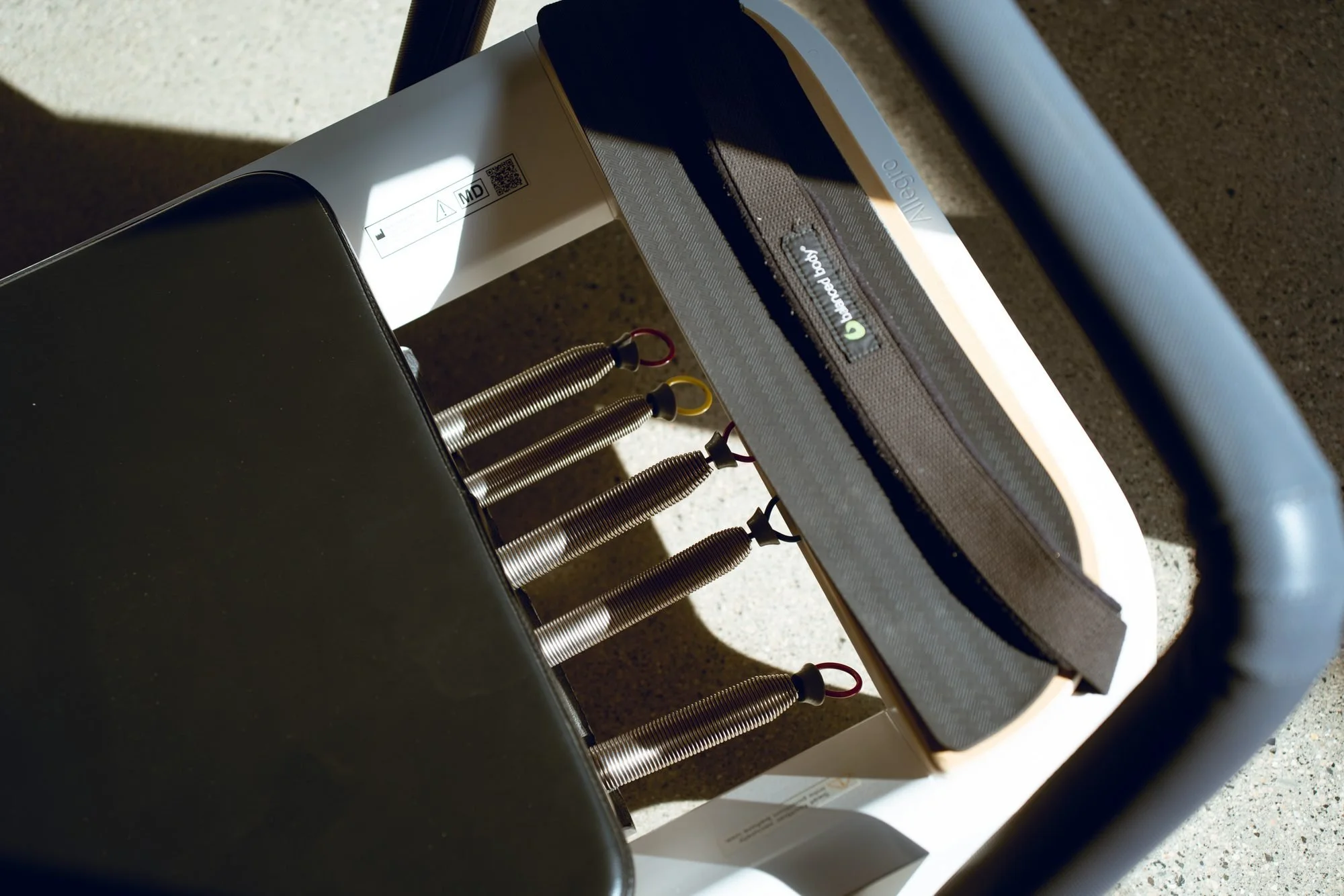
The reformer is a spring-loaded carriage that slides on rails, with adjustable resistance, straps, and a footbar. You add or remove springs to change the load, and the moving carriage gives your body constant feedback about alignment and control.
Here’s the part most articles get wrong: spring resistance and support make the reformer harder and more accessible at the same time. The springs can load a movement to challenge a strong athlete, or assist a movement so a beginner or someone rehabbing can perform it with control they couldn’t find on the mat. Same machine, opposite effects, depending on setup.
For the full breakdown of the machine, springs, and what each part does, see our guide to the reformer machine.
The Real Difference Between Reformer and Mat (and the Myth Worth Killing)
The most common thing people believe is that "the reformer is just the harder version of mat Pilates." It isn’t.
The reformer can make a movement easier or harder than the same movement on the mat. Light springs assist a footwork or a bridge so a deconditioned client can move through a full, supported range. Heavy springs load a press or a pull so a trained body meets real resistance. The mat gives you one resistance setting: your bodyweight against gravity. The reformer gives you a dial.
That’s the actual distinction. Not "mat is easy, reformer is hard," but "mat is fixed resistance, reformer is adjustable resistance — in both directions." Once you understand that, the question stops being which one is harder and becomes which one fits what you’re trying to do.
The Reformer Exposes What the Mat Hides
There’s a second difference that matters as much as resistance: the reformer shows you your imbalances, and the mat lets you bury them.
The carriage runs on rails, and the springs load each side independently. Push or pull unevenly and the carriage skews, or one strap pulls harder than the other — your stronger side gets caught in the act. On the mat, a dominant side quietly takes over and you’d never know. Most people are more lopsided than they think, and the reformer is the thing that tells them.
That same feedback trains posture. Controlling the carriage on the way back in — slowing the return instead of letting the springs snap it home — loads the deep muscles that hold you upright and keeps your alignment honest. You’re not just doing the movement. The machine is correcting you while you do it.
This is where a class of six earns its keep: the reformer flags the imbalance, and the instructor catches it and fixes it before it becomes a habit.
Which One You Actually Need
Brand-new to Pilates. Either works, but the reformer’s feedback shortens the learning curve. The carriage tells you when you’re stable and when you’re not, which is harder to feel on the mat. Many people find form clicks faster on the machine. If you’re starting from scratch, our Pilates for beginners guide covers the basics either way.
Coming back from a back issue. This depends on the specific back, and it’s worth saying plainly: no format is universally "good for backs." That said, the reformer’s adjustable support lets you work in a reduced-load, well-supported range, which many people find more manageable early on. If you’re returning from a lower-back problem, read our post on Pilates and lower back pain and clear exercise with your clinician first.
Building real strength. The reformer wins on progressive load. You can add springs and increase resistance over time the way you’d add weight in a gym. Mat strength is real but caps out at your bodyweight and leverage.
Surfers and athletes. Reformer, mostly. Single-sided sports like surfing quietly build asymmetries, and the reformer is good at exposing and correcting them — its adjustable resistance and rotational, single-side work translate directly to sport-specific strength and control. We get into this in our post for surfers.
Traveling vs. based here. If you’re constantly on the move, a mat practice is the one that comes with you. If you’re based in or staying in Nosara for a stretch, the reformer is worth building a routine around while you have consistent access to one. And access is getting easier everywhere: reformer Pilates bookings rose 71% year over year in 2025, and Pilates was the most-booked workout in the world for the third year running, according to ClassPass. Studios are multiplying to match.
Do You Need Both?
The whole reformer vs. mat Pilates question assumes you have to pick one. Most people don’t actually have to choose. Mat and reformer are complementary: the mat builds the bodyweight control and home-practice habit, the reformer adds load, support, and variety. If you can do both, do both. If you can only do one, pick based on the situations above.
Where This Lands at BCS
Black Cat Studio is reformer-based, and we cap classes at six so the instruction stays close and corrective — that closeness is the core of our method. If you want to feel the difference for yourself, book a class.
FAQ
Is reformer Pilates harder than mat?
Not necessarily. The reformer can be set up to be harder or easier than the mat, depending on spring load. Heavier springs add resistance; lighter springs assist the movement, which can make some exercises more accessible than their mat versions.
Should beginners start on mat or reformer?
Either is fine, but many beginners find the reformer easier to learn on. The moving carriage gives constant feedback about alignment and stability, which is harder to sense on the mat. Mat is the better choice if your priority is a low-cost, anywhere practice.
Is reformer Pilates better for back pain?
It depends on the individual and the cause of the pain, so no format is universally "better." Pilates is reasonably well-regarded as one option for chronic low back pain, and the reformer’s adjustable support can let some people work in a more manageable range. Anyone with a current or recent back injury should clear exercise with a qualified clinician first.
Can you build strength with mat Pilates alone?
Yes, within limits. Mat builds real strength through bodyweight resistance and leverage, especially in the core. The ceiling is lower than the reformer’s because you can’t add external load, so progress eventually plateaus without other resistance.
Do I need to do both?
No. They’re complementary, not mutually exclusive, and most people do well with either one. If you have access and time for both, they reinforce each other; if not, choose based on your goals and where you’ll practice.