
What Semi-Private Pilates Actually Is (and Why Our Classes Cap at Six)
"Semi-private" gets used loosely, usually to make a regular group class sound fancier than it is. So before it means anything, here's the honest version — what it actually is, what you get that a big class can't give you, and why our reformer classes cap at six.
What "semi-private" actually means
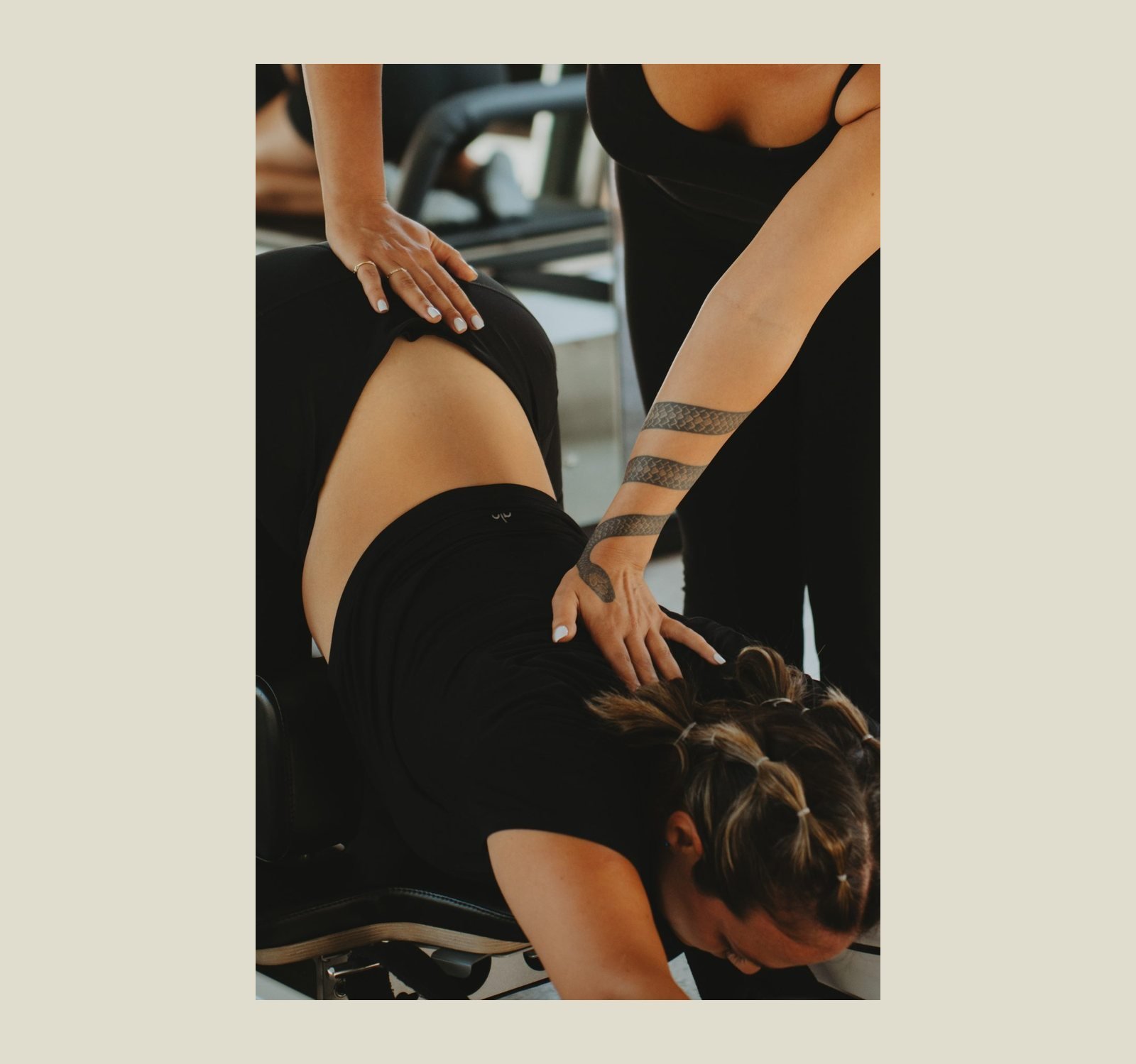
Semi-private is a small group, taught like a private. You're in a room with a handful of other people, each on your own reformer, but the instructor is close enough to see your form, correct it, and adjust the work to your body in real time. It sits between two things most people already know.
The three-way tradeoff: private, semi-private, big group
A private session is one instructor, one person. Total attention, fastest progress, highest price. Worth it for rehab, specific goals, or people who want to be coached hard one-on-one.
A big group class — the 12-to-20-person model most studios run — is the opposite. It's affordable and social, but the instructor physically can't watch everyone. You follow along, you copy the person in front, and nobody catches that you're loading the wrong muscle. It works until it reinforces a bad pattern.
Semi-private is the middle that keeps the useful parts of both: the individual eye of a private, at something much closer to a group price. The catch is that it only works if the group is genuinely small. Which is the whole argument for the number.
Why six, and not twelve
Six is the largest a class can be while the instructor still sees every person, every rep. Past that, attention gets rationed — the instructor drifts toward the people struggling most and the rest are on their own. At six, on six reformers, there's no drifting. Everyone gets corrected. That's not a marketing cap; it's the point where "semi-private" stops being true.
What you actually get that a big class can't
Individual cueing. This is Precision First — the first pillar of the Black Cat Method. In a class of six, the cue you hear is aimed at you: your hip that drops, your shoulder that creeps up, your spring setting that's wrong for your build. You're not getting a generic instruction broadcast to a room. That's the difference between doing reformer Pilates and doing it correctly, and it compounds every single class.
It also means the work scales to you. A beginner and a regular can be in the same reformer class and both be appropriately challenged, because the instructor is adjusting per person instead of teaching to the middle.
Who it's for
Beginners who want to learn the movement right the first time instead of unlearning bad habits later. Experienced people who've plateaued in big classes because nobody's progressing them. Anyone working around an old injury who needs eyes on their form. If your goal is to actually get better — stronger, more mobile, more precise — rather than just tick off a workout, semi-private is built for that.
Is it worth the difference
You'll pay more than a drop-in at a 20-person studio and less than a one-on-one private. What you're buying with that difference is attention — the thing that makes the work do anything. A cheap class you do wrong for a year isn't cheaper than a class you do right. See the full prices and packages for where it lands.
FAQ
What is semi-private Pilates?
Semi-private Pilates is a small-group class — at Black Cat, a maximum of six people, each on their own reformer — where the instructor still gives individual form correction and adjusts the work to each person. It sits between a one-on-one private and a large group class.
How is semi-private different from a private session?
A private is one-on-one with the instructor's full attention, at the highest price. Semi-private keeps the individual cueing but in a small group, at a lower per-class cost. Privates suit rehab or specific goals; semi-private suits people who want coached, correct training without the private price.
How many people are in a semi-private class?
At Black Cat, six is the cap. That's the largest group in which the instructor can still see and correct every person every class. Beyond roughly six, attention gets rationed and it stops being genuinely semi-private.
Is semi-private Pilates good for beginners?
Yes — it's arguably best for beginners. You learn the movements correctly from the start with an instructor watching your form, instead of copying along in a large class and building habits you'll have to undo later.
Is semi-private worth more than a big group class?
If your goal is to actually improve, yes. The extra cost buys individual attention, which is what makes the work effective. A large, cheap class you perform with poor form doesn't deliver the same results, no matter how many you do.
Reformer Pilates, six people max, in Nosara. See class times and book.